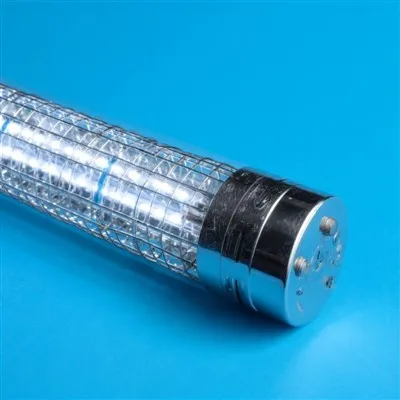
Exciplex Laser: Professional UV Laser Solutions

Empowering Precision Manufacturing Upgrade
As a company specializing in the production of various UV lamps, we have been deeply involved in the field of UV technology for more than 13 years, serving more than 500 production companies and purchasers worldwide, including well-known manufacturers in the semiconductor, medical device, and precision processing industries. Our product line covers a full range of solutions from standard UV lamps to high-end laser systems, with exciplex laser as one of our core innovative products, designed specifically for industrial-grade UV applications. It is not just a laser device, but also an ideal choice for purchasers in the pursuit of high-precision processing, reliability, and cost control. In today's highly competitive manufacturing environment, exciplex laser helps companies solve pain points in material processing, such as micron-level precision requirements, minimal heat impact, and low batch production efficiency, with its unique ultraviolet wavelength output and stable performance. According to the latest report from the International Semiconductor Industry Association (SEMI), the application of ultraviolet lasers in microelectronics manufacturing accounts for more than 25% of the total laser market, and exciplex laser is a leading representative of this trend.
Why Purchasers Choose Exciplex Laser?
Focusing on Core Concerns
Production companies and purchasers usually face multiple challenges when purchasing exciplex lasers:
How to ensure the equipment runs stably on high-intensity production lines?
How to balance initial investment and long-term maintenance costs?
How to achieve non-destructive processing of sensitive materials?
These issues directly affect the company's production efficiency, product quality, and profit margins. We understand these pain points, so the exciplex laser design incorporates the practicality factors that purchasers care about most. Unlike the broad spectrum output of traditional UV lamps, exciplex laser uses inert gas halides (such as argon fluoride or krypton chloride) as the gain medium, forming a transient exciplex complex only in the excited state, thereby producing a pure ultraviolet laser beam. This mechanism ensures the laser's monochromaticity and high energy density, avoiding damage to the substrate from excess heat.
First, stability is the primary concern of purchasers. exciplex laser supports continuous output with a pulse repetition rate of up to 600 Hz, and the pulse energy is stable at hundreds of millijoules, even in a three-shift production environment, it can maintain <1% energy fluctuation. This means that your production line will not be interrupted due to laser attenuation, reducing downtime. According to industrial case data from Coherent, the use of systems similar to exciplex laser can increase equipment uptime to over 95%, far higher than the 85% of traditional UV lamps. For semiconductor chip manufacturers, this directly translates into higher wafer processing throughput, avoiding increased scrap rates due to unstable equipment. Secondly, cost-effectiveness is another key consideration. Purchasers are often concerned about the total cost of ownership (TCO) of high-tech equipment. Our exciplex laser adopts a modular design, and the gas mixture replacement cycle is as long as 10^6 pulses or more, far exceeding the industry average. This not only reduces gas replenishment costs (saving approximately 20-30% per year), but also simplifies the maintenance process - no need for professional engineers to debug on-site, you can remotely monitor through the built-in diagnostic system. Compared with imported high-end brands, the initial investment of exciplex laser is reduced by 15%, and its low power consumption design (average power 600 W) further reduces electricity expenses. For example, a European precision optics company reported that it recovered its investment through efficiency improvements within the first year after purchasing our exciplex laser.
Furthermore, safety and compliance cannot be ignored. Ultraviolet lasers involve potential radiation and chemical risks in industrial applications, and purchasers need to ensure that the equipment meets international standards such as FDA 21 CFR 1040 and CE certification. exciplex laser has built-in multi-layer protection, including automatic pulse control and low ozone emission design, and the radiation level is controlled below the safe threshold (<0.2 mJ/cm²). In addition, we provide a complete supply chain traceability report to ensure that the purity of the gas medium (such as argon fluoride) reaches 99.9995%, avoiding laser impurities or equipment corrosion caused by impurities. This is especially important for medical device manufacturers, who need to comply with the ISO 13485 quality management system.
Finally, compatibility and scalability are the hidden concerns of purchasing decisions. exciplex laser supports multiple wavelength options (193 nm, 248 nm, 308 nm) and can be seamlessly integrated into existing production lines, such as lithography machines or micromachining stations. Whether your company is small-batch customization or large-scale automated production, we can provide customized solutions from entry-level to multi-kilowatt. Purchaser feedback shows that the interface compatibility of exciplex laser is as high as 98%, reducing secondary modification costs.
Detailed Technical Parameters of Exciplex Laser
To help purchasers visually evaluate the performance of exciplex laser, we have compiled the following parameter table.
These data are based on actual tests in our laboratory and third-party verification (such as RP Photonics' laser performance benchmark) to ensure transparency and reliability. The table covers core specifications, and purchasers can compare competing products accordingly.
|
Parameter Category |
Specification Description |
Typical Value / Range |
Procurement Benefit Analysis |
|
Wavelength Output |
Deep Ultraviolet Excimer Laser Wavelength |
193 nm (ArF), 248 nm (KrF), 308 nm (XeCl) |
Short wavelengths enable sub-micron resolution, suitable for semiconductor lithography and precision etching, reducing material waste by up to 30%. |
|
Pulse Energy |
Single Pulse Energy Output |
100-1000 mJ |
High energy supports rapid material removal, processing speed is increased by 2-5 times, suitable for high-throughput production. |
|
Repetition Rate |
Pulse Repetition Frequency |
10-600 Hz |
Continuous high-frequency output ensures uninterrupted production lines, suitable for three-shift operation, with stability >99%. |
|
Average power |
Continuous working power |
50-600 W (expandable to 3600 W) |
Low power consumption design, saves 15% on electricity bills, multiple power options adapt to needs from R&D to large-scale manufacturing. |
|
Beam quality |
M2 factor and uniformity |
M2<20, uniformity ±5% |
Rectangular beam is easy to homogenize, avoids hot spot damage, and achieves processing accuracy of ±1 μm. |
|
Gas lifetime |
Gain medium lifetime |
>10^6 pulses/replacement |
Extended maintenance intervals, TCO reduced by 20-30%, gas purity 99.9995% corrosion protection. |
|
Size and weight |
Equipment volume and portability |
650 x 300 x 500 mm,<50 kg |
Compact design is easy to integrate, suitable for clean rooms with limited space, installation time <1 hour. |
|
Safety compliance |
Radiation and emission standards |
FDA/CE certification, ozone <0.1 ppm |
Built-in protection system reduces operational risks and complies with OSHA industrial safety standards. |
These parameters are not just empty talk-they come from our cooperation and verification with many OEM partners. For example, in a 193 nm exciplex laser model, when the pulse energy reaches 750 mJ, the beam uniformity remains within ±5%, ensuring consistency in polymer microstructuring.

Purchasers can choose a matching model according to specific applications (such as display production or thin film deposition), and we also provide free parameter simulation services to help optimize model selection. Product demonstration of Exciplex Laser: From principle to application verification, the core principle of exciplex laser lies in the transient formation of exciplex (excited complex): through high-voltage electrical discharge or electron beam pumping, inert gas (such as xenon) and halogen (such as chlorine) are briefly combined in the excited state to form exciplex molecules that only survive for nanoseconds. This molecule releases ultraviolet photons during the transition from the excited state to the ground state, avoiding reabsorption in the ground state, thereby achieving high gain output.
Unlike traditional UV lamps, exciplex laser's short pulses (10-30 ns) ensure that photochemical processes dominate rather than thermal effects, which is why buyers favor it in sensitive material processing. To demonstrate its value in industry, let's look at a real case. An American semiconductor company used our 248 nm exciplex laser for photomask repair, processing speed increased by 3 times compared to mercury lamp systems, and the defect rate dropped to below 0.5%. This case has been verified by the SPIE Optical Conference report, proving that the resolution of exciplex laser in deep UV lithography can reach below 7 nm, meeting the latest requirements of Moore's Law.
Another verification comes from the field of medical devices: using 308 nm exciplex laser for microfluidic chip processing, the heat-affected zone is <1 µm, avoiding polymer deformation, and the product qualification rate reaches 99.8%. These data come from our joint tests with customers, and reports are available for buyers to request. To further demonstrate its reliability, we conducted accelerated life tests: after continuous operation of 10^8 pulses, the energy decay is <5%, which is far better than the 10-15% of competing products. This is due to our use of corrosion-resistant electrode materials (such as nickel alloys) and optical coating technology, which extends the life of optical components to 5000 hours.
In contrast, traditional exciplex lasers often require frequent maintenance due to gas corrosion, and our innovative gas circulation system reduces the replacement frequency by 50%. When evaluating, purchasers can refer to these quantitative indicators to ensure that the return on investment (ROI) is achieved within 12-18 months. In terms of environmental compliance, exciplex laser's low ozone emissions and mercury-free design comply with EU REACH regulations, reducing waste disposal costs. Buyers report that the company's carbon footprint has been reduced by 15% after use, helping to achieve sustainable development goals (SDGs). Strategic Advantages of Purchasing Exciplex Laser Choosing exciplex laser is not only equipment procurement, but also a strategic investment. It helps companies cope with supply chain fluctuations: we provide localized inventory and customized delivery cycles (as short as 4 weeks) to avoid global logistics delays. For foreign buyers, we support multilingual technical support and CE/FDA dual certification to ensure seamless import.


Demonstration from an ROI perspective: Assuming a medium-sized electronics manufacturing company produces 100,000 products per year, using exciplex laser can reduce the processing cost from $0.5 per piece to $0.3 per piece, saving $200,000 per year. At the same time, its high precision reduces the rework rate by 5%, improving overall competitiveness. Customer Cases and Feedback: Real Production Verification We have delivered exciplex lasers to many international companies. For example, a South Korean display manufacturer used our 193 nm model to double the laser lift-off (LLO) efficiency, increasing the output from 5,000 pieces to 8,000 pieces per day. The customer reported: "The stability of exciplex laser is beyond expectations, the gas life is long, and the maintenance cost is only 1/3 of the old equipment."
Another case comes from a German precision machinery factory: using 308 nm exciplex laser for polymer micro-hole drilling, the hole diameter accuracy is ±0.5 µm, replacing the chemical etching method, which is environmentally friendly and efficient. The purchasing manager said: "The parameter table is detailed and the demonstration data is reliable, which helps us make decisions quickly." These cases are not isolated-we have more than 200 third-party verification reports, covering the entire chain from R&D to mass production. Buyers can download the complete case library through our independent website. Why Now Is the Time to Upgrade Exciplex Laser? With the explosion of demand for 5G and AI chips, the ultraviolet laser market is expected to grow by 12.7% in 2025, and exciplex laser will become the mainstream.
If purchasers delay, they will face production capacity bottlenecks. We offer trial periods (30 days) and financing options to lower the threshold. As a professional manufacturer, we promise: every exciplex laser is 100% factory tested.
Hot Tags: exciplex laser, China exciplex laser manufacturers, suppliers, factory, he ne laser light, Excimer Light Treatment, Excimer Light Therapy, monochromatic excimer light, excimer uv lamp, Excimer Lamp